
Deacon Spotlight: Katharine Farrell
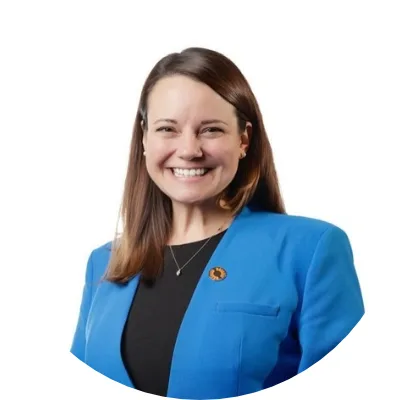
Katharine Farrell (2009, BA in History; 2015, Master of Business Administration)
Vice President, Americas, Global Business Travel Association (GBTA) in Atlanta, GA
Tell us about your current job role and employer. What are you currently working on?
I’m Vice President, Americas for the Global Business Travel Association (GBTA), where
I lead strategy, engagement and growth across the U.S., Canada, and Latin America. I
joined GBTA in January 2026 after spending much of my career in travel, marketing and
communications, including roles at Delta Air Lines and travel technology company
Serko, as well as several years running my own marketing agency.
What I love about my current role is the variety. On any given day, I may be thinking
about how we grow our membership, developing programs and events, working with
volunteer leaders, engaging with industry partners, or thinking more broadly about how
GBTA can best serve the business travel community. Right now, a lot of my focus is on
shaping our three- to five-year strategy for the Americas while planning for 2027 and
continuing to strengthen our communities and programs.
What key personal and/or career experiences led you to where you are today?
My career has definitely not followed a straight line, and I’m grateful for that. I graduated
from Wake Forest with a degree in History and later returned to Wake for my MBA
through the Winston-Salem Evening program. My early career was in collegiate and
professional sports, before moving into the corporate travel industry.
One of the most formative experiences was starting my own marketing and
communications agency. I built the company, grew it and eventually sold it. That
experience taught me an enormous amount about leadership, risk, client relationships,
and the importance of being flexible and adaptable. From there, roles at Delta and
Serko broadened my experience with larger, global organizations before I joined GBTA.
Looking back, what connects all of those experiences is people. I’ve always gravitated
toward roles where I can bring people and ideas together, solve problems, and build
something that creates value for others.
What is the most challenging aspect of your job? How do you navigate that challenge?
Probably the breadth of it. My role spans three very different markets across the
Americas, a wide range of stakeholders, and a lot of competing priorities. There’s rarely
a shortage of good ideas or worthwhile things we could be doing, so the challenge is
determining where we can have the greatest impact.
I try to navigate that by staying focused on the “why” behind the work: Who are we
serving? What problem are we solving? What outcome are we trying to achieve? I also
rely heavily on my team. I believe strongly that good leadership isn’t having all the
answers yourself. It’s creating enough clarity and trust that talented people can do their
best work.
What advice would you give to Wake Forest graduates about developing their personal life habits after college (finances, health, values, work/life balance)?
Give yourself permission not to have everything figured out immediately. Early in your
career, it’s easy to focus on the next title, salary, or milestone and assume you’ll pay
attention to everything else once you’ve “made it.” There really isn’t a moment when life
suddenly becomes less busy.
Build the habits early that support the life you actually want: automate saving, take care
of your health, invest in friendships and family, and make room for your faith and values.
And understand that balance will look different in different seasons. Sometimes work will
demand more; sometimes your family will. The goal isn’t perfect balance every day. It’s
making sure that, over time, your calendar reflects what you say is important to you.
We know that relationships are important for any kind of development. How do you build and maintain your network?
I think the best networks are built through genuine relationships rather than
“networking.” Some of the most important professional relationships in my life started
because we worked together, solved a difficult problem together, or simply enjoyed
talking to each other.
I try to stay curious about people, make introductions when I think two people should
know each other, and be helpful without always expecting something in return. And I try
to maintain relationships even when I don’t need anything. A quick text, congratulations
on a new role, grabbing coffee when you’re in the same city, or checking in because
something reminded you of someone can go a long way.
The travel industry is also remarkably relationship-driven, so I’ve learned that the
connections you make early in your career can come back into your life in unexpected
ways many years later.
Tell us about your mentoring relationships. What impact have these relationships had on your career and life?
I’ve been fortunate to have mentors at different stages of my career, although many of
the most important mentoring relationships weren’t particularly formal. They’ve been
former bosses, colleagues, and friends who were willing to give me honest advice,
advocate for me, challenge my thinking or help me see an opportunity differently. I’ve
also had the opportunity to participate in structured mentoring programs through Delta
(LEAD Cargo, Global Sales & Distribution) and GBTA (GBTA Ladders, WINiT).
As my career has progressed, I’ve also realized that mentorship doesn’t have to flow in
only one direction. I learn a tremendous amount from the people I lead and from
colleagues who have experiences and expertise very different from mine.’
The biggest impact those relationships have had is perspective. At important moments
in my career, having someone who could step outside the situation and ask the right
question has often been more valuable than having someone give me their answer.
What advice would you give to current Wake Forest students and/or young alumni who are interested in working in your industry?
First, remember that “the travel industry” encompasses more than leisure, and provides
a myriad of career opportunities beyond the hotel front desk (although there are plenty
of senior leaders I know who began their careers there!). My business travel corner of
the industry includes technology companies, corporate travel programs, consulting,
meetings and events, payments, sustainability, data, associations, and many other
areas. There are opportunities for almost every skill set.
Second, don’t underestimate the importance of relationships. Go to industry events,
reach out to alumni, ask people about their careers and be genuinely curious.
And finally, be willing to take the job that doesn’t fit perfectly into the career plan you
created for yourself. My own career has moved through sports, higher education,
entrepreneurship, marketing, technology, an airline, and now an association. I couldn’t
have mapped that path when I graduated from Wake Forest, but each experience gave
me something I needed for the next role.
What’s next for your career? What future goals or plans are you pursuing?
Frankly, I’m still very focused on what’s in front of me. I joined GBTA this year, and there
is a tremendous amount that I’m excited to build.
Professionally, I want to continue growing as a leader, and helping build organizations
and teams that are ambitious, collaborative and genuinely valuable to the people they
serve. Right now, that means helping shape the next chapter of GBTA’s work across the
Americas and making sure we’re building for where the industry is going, not simply
maintaining what has worked in the past.
Longer term, I’ve learned not to be too prescriptive about what comes next. Some of the
best opportunities in my career weren’t part of the original plan.
Story published in October 2026. For current updates about Katharine, visit her LinkedIn profile.