
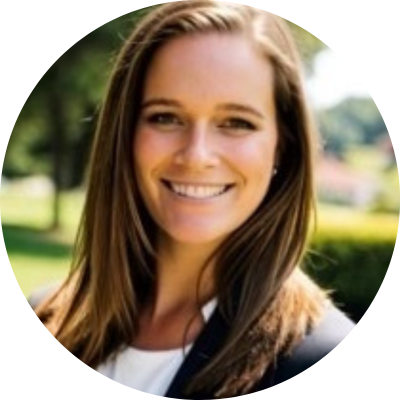
Deacon Spotlight: Amy Walldorf
Amy Walldorf (2018, BS in Biology, Minor in Studio Art)
Partnership Manager at Allyant in Denver, CO
Tell us about your current job role and employer. What are you currently working on?
Allyant is an end-to-end digital accessibility company supporting the auditing and remediation of websites and PDFs to be accessible to blind and low vision users who access the internet with a screen reader.
I am the leader of our partnership efforts. I am responsible for growing existing partnerships by providing them with sales enablement, expert support, marketing materials, and any other resources they need to sell our product or refer clients to Allyant. I am also responsible for identifying organizations in the marketplace that are primed for a mutually beneficial partnership with Allyant and negotiating those agreements.
What key personal and/or career experiences led you to where you are today?
Like anyone, my life and career have included real wins and real setbacks. Both shaped me, but honestly, it’s the setbacks I’m most grateful for.
In the moment, a closed door always stings – whether it was the consulting role I didn’t get, promotions and career pivots I wasn’t able to obtain, or even losing a job that had drained and overwhelmed me. But every time something didn’t work out, it quietly redirected me somewhere better.
Those harder seasons taught me more than any easy success ever could. They clarified what I value, the kind of managers and teams I thrive with, and where my strengths actually lie.
What is the most challenging aspect of your job? How do you navigate that challenge?
At the beginning of 2026, I transitioned from an individual contributor role into management, which has brought an exciting new set of challenges. In sales, my focus was clear: what’s best for the customer, the deal, and the company in front of me.
Now, as the leader of our partnership efforts, my scope is broader. I’m responsible for evaluating market trends, weighing the long-term risks and benefits of aligning our brand with partner organizations, and independently owning partnership revenue. Shifting from execution to strategy has been both demanding and energizing.
I’ve navigated this transition by leaning on mentors and cross-functional stakeholders who are invested in strong partnerships and generous with their guidance. Just as importantly, I’ve learned to give myself permission to grow through the process. Leadership requires comfort with uncertainty, and I see mistakes as part of building long-term capability.
What advice would you give to Wake Forest graduates about developing their personal life habits after college (finances, health, values, work/life balance)?
Follow your curiosity — seriously. Protect it.
When I graduated from Wake and stepped into the “real world,” I didn’t expect to miss my extracurriculars so much. In college, life is naturally multidimensional: intramural sports, dance competitions, random electives, late-night creative projects, classes you took just because they sounded interesting. You are constantly learning and becoming.
After graduation, that variety can quietly disappear. Suddenly, life narrows to one thing: your job.
Your job matters, but it isn’t your whole life.
So invest in the interests that don’t fit neatly into your 9–5. Try new hobbies. Take a class. Join a rec league. Make something with your hands. Stay curious on purpose. Don’t come home and rot — build a life that feels full outside of work.
We know that relationships are important for any kind of development. How do you build and maintain your network?
Networking used to intimidate me. It felt transactional and awkward — like something I was supposed to be good at but didn’t naturally understand.
Eventually, it clicked that networking is really just making friends. And I’m good at that.
Once I stopped treating it like a formal exercise and started focusing on genuine connection — being curious about people, staying in touch, offering help when I can — everything got easier. The strongest professional relationships in my life grew from real conversations, not perfectly crafted coffee chats.
Friendships endure. Transactional networking doesn’t.
Tell us about your mentoring relationships. What impact have these relationships had on your career and life?
I don’t think you can ever have too many mentors.
Over time, I’ve realized mentors don’t just show up as formal advisors — they’re professors, managers, colleagues, and even friends. Every person you work with has something to teach you, whether it’s a quality you want to emulate or a reminder of the kind of leader you don’t want to be.
I’ve benefited enormously from paying attention to those small lessons and collecting wisdom from lots of different places. You don’t have to follow any one person’s path exactly — you can take what resonates, leave what doesn’t, and build a version of success that feels authentic to you.
What advice would you give to current Wake Forest students and/or young alumni who are interested in working in your industry?
My career has been surprisingly industry-agnostic — I’ve worked across healthcare, recruiting software, cybersecurity, and now accessibility tech. If there’s one thing I’ve learned, it’s that skills travel farther than industries do.
Early on, focus less on picking the “perfect” sector and more on building strong fundamentals: how to communicate clearly, solve problems, and learn quickly. Those skills will open doors everywhere.
That said, accessibility has been the most meaningful work I’ve done. It sits at the intersection of technology, equity, and real human impact — and with new legislation like Title II of the ADA, it’s also a fast-growing space with huge opportunity.
If you’re curious about the field, start small and hands-on. Learn the basics of digital accessibility. Explore document tagging. Try navigating a website with a screen reader. Once you experience the internet from a different perspective, the importance of this work becomes obvious — and you’ll immediately stand out to employers.
What’s next for your career? What future goals or plans are you pursuing?
I am hoping to have a life full of varied chapters. I love what I’m doing now, and I have a lot to learn in my new role. I’ll continue taking on bigger challenges, growing my skillset, and earning larger responsibilities. In time, the hope is that my efforts lead to more promotions, and more opportunities.
That being said, I continue to consider a multitude of paths for my life – if I won the lottery I’d probably get a masters in Egyptology, I’d like to write a book one day, and I refuse to throw in the towel before I’ve owned a hobby farm of rescued barnyard animals.
The point is – I hear a lot of people lament that they don’t know what they want to do with their life, I used to be one of them. I have no idea where I’ll be in 5, 10, 20 years – how exciting!
The options are endless, we get one life, let’s make it a good story.
Story published in February 2026. For current updates about Amy, visit her LinkedIn profile.